

In this series I am drawing out reflections from a recent journey to Kenya.
—
Given the honor of addressing Kenyan church leaders, I felt compelled to begin with a consideration of missions history in Africa. Some of that came by way of simply asking the room, “What is God doing here?” The stories that emerged were evidence of that history, fruit born of the gospel seed in African soil.
Yet at the risk of being patronizing—because they were more informed than me on the topic—I offered a brief survey of African participation in the gospel’s early movement. Perhaps hearing a Westerner acknowledge and value it was more meaningful than the content itself.1
For the sake of brevity, I began at Pentecost.2 In Acts 2 Luke tells us that African Jews and proselytes from “Egypt and the parts of Libya belonging to Cyrene” were present at the coming of the Holy Spirit (v. 10). Assuming some of them believed and were baptized that day, we may say that Africa has had a place at God’s table from the church’s beginning.
Then in Acts 8, an angel of the Lord sent Philip away from the crowds in Samaria and down a desert road, where he encountered an Ethiopian official returning from Jerusalem.
Of course, the “Ethiopia” of Luke’s world was not identical to today’s Ethiopia. It referred more broadly to the African lands south of Egypt—probably, in this case, the kingdom of Cush in the region of modern Sudan. But the significance is clear: very early in the outward movement of the gospel, God directed Philip toward an African.
The man was reading Isaiah’s description of the suffering servant, but he did not understand whom the prophet was describing. Acts 8:35 gives us this beautiful sentence: “beginning with this Scripture [Philip] told him the good news about Jesus.” That is the center of the story. Philip did not bring him civilization, colonization, political system, or foreign culture. He announced Jesus—the Son of God who suffered for sinners, died, and rose again.
The initiative belongs to God. The gospel flowed to this African as a gift. The official was baptized, and Luke tells us that he went on his way rejoicing. And notice where it appears in Acts: before Paul crosses into Europe or reaches into Rome, an African receives the gospel and it begins flowing through him. As the good news moves toward the ends of the earth, Africa is immediately present in the story.
And that presence did not end on the road from Jerusalem to Gaza. Within the early centuries of the church:
Alexandria became a center of Christian teaching.
Athanasius defended the church’s confession that Jesus is truly God.
Christians in the Egyptian desert taught the wider church about prayer and life with God.
Tertullian, Cyprian, and Augustine helped shape the Christian theology on which all believers now stand.
In the kingdom of Aksum, the cross of Christ began appearing even on the nation’s coins.
These African Christians were not minor characters in global missions. God used the church in Africa to strengthen, defend, and enrich the faith of the whole church.3
My question at this point in the address was this: Do your church members know this great heritage?
As missions awareness sweeps across the continent, is it framed as merely joining a Western phenomenon, or the renewal of that which their own ancestors pioneered for us all: a Spirit-filled, doctrinally-rich, uniquely African contribution to global missions? For what it’s worth from a grateful American, as Mufasa says to his son Simba in The Lion King, “Remember who you are.”4
Of course, this history was never uniform. To say that the gospel came early to Africa does not mean that every African people received it—or that every community has meaningful access to it today. The gospel can be ancient among one people and barely known among another living nearby. It can be new in one place while forgotten somewhere next door. Both realities can be true.
Remembering Africa’s Christian inheritance does not minimize Africa’s remaining gospel need. My hope is that it gives the African church both confidence and responsibility in the face of that need. And beyond.
As Thomas C. Oden writes, “The pretense of studying church history while ignoring African church history is implausible. Yet this assumption has been common in the last five centuries in a way that would have seemed odd during the first five centuries, when the African mind was highly honored and emulated.” Thomas C. Oden, How Africa Shaped the Christian Mind: Rediscovering the African Seedbed of Western Christianity (Downers Grove: InterVarsity, 2007), 9-10
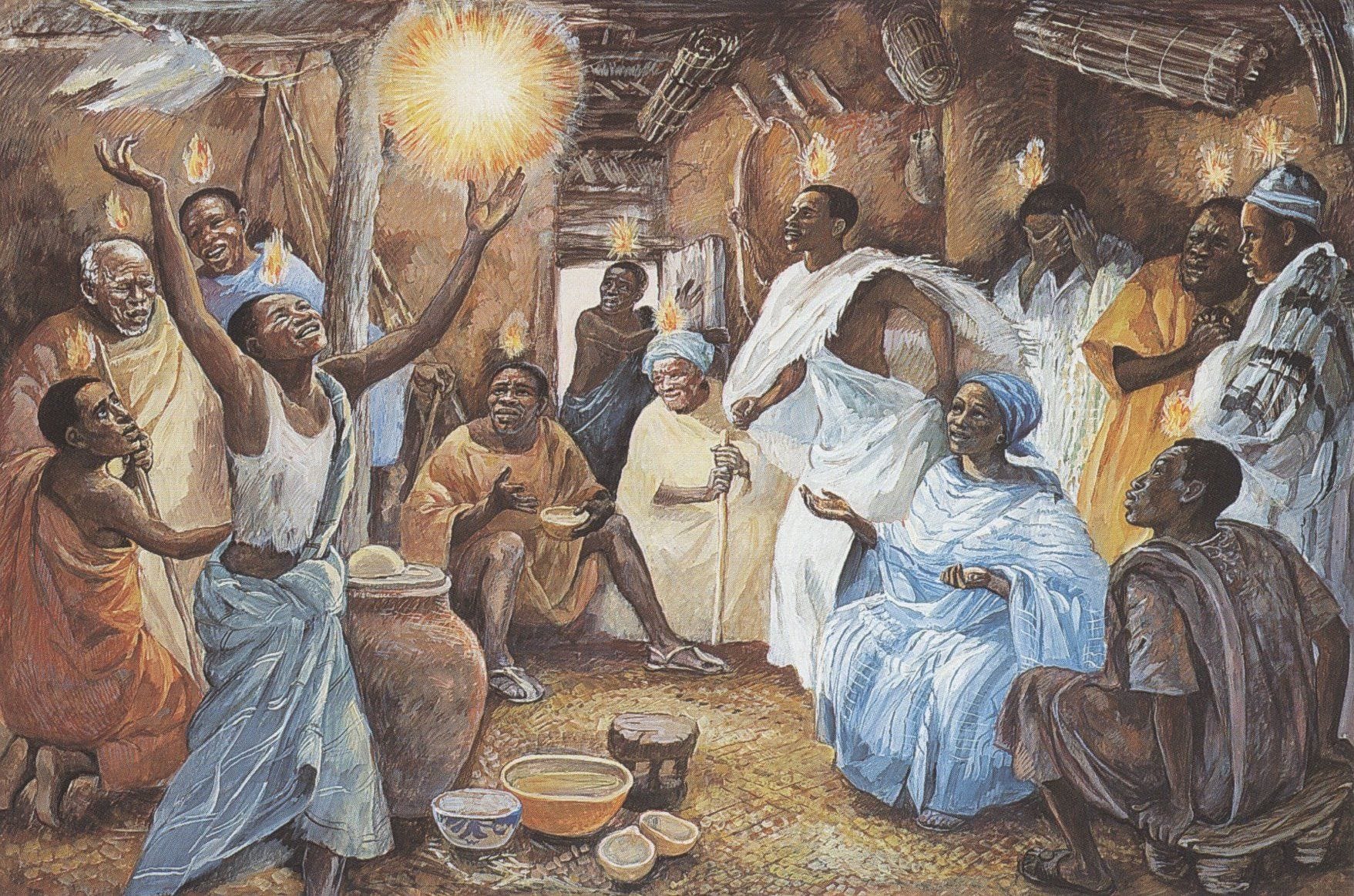
The art for today’s publication is a Cameroonian representation of Pentecost, used with permission: JESUS MAFA. Pentecost, from Art in the Christian Tradition, a project of the Vanderbilt University Divinity Library, Nashville, TN. https://act.library.vanderbilt.edu/artworks/48388 [retrieved October 13, 2026]. Original source: http://www.librairie-emmanuel.fr (contact page: https://www.librairie-emmanuel.fr/contact).
Again from Oden: “Africa played a decisive role in the formation of Christian culture. Decisive intellectual achievements of Christianity were explored and understood first in Africa before they were recognized in Europe, and a millennium before they found their way to North America. Christianity has a much longer history than its Western or European expressions. The profound ways African teachers have shaped world Christianity have never been adequately studied or acknowledged, either in the Global North or South.” Ibid., 9
FilmZone Tv, “The Lion King | Remember Who You Are (Mufasa Appears To Simba),” Youtube, 18 December 2017