


Scars are fascinating things.
We all have them. Most are hidden; many are invisible. Whether they come from physical or emotional wounds, our natural tendency is to conceal them. Scars can feel embarrassing—a reminder of hard times, a picture of our vulnerability, a mark left by something we would rather forget.
Take a moment and consider where yours are.
I don’t know what it is about me, but throughout my life people have shown me their scars. When I was in first grade, the school brought me into a classmate’s counseling sessions because I was the only person he would talk to. Complete strangers have spilled their guts to me, only to stop suddenly and say, “I don’t even know why I’m telling you this.” People I’ve visited in the hospital have pulled back their bandages to show me their wounds.
It’s strange.
But never as strange as it would be for someone to invite me to put my finger into their wounds.
The Scars He Kept
This is precisely what the risen Jesus invited Thomas to do. After Jesus appeared to the disciples, Thomas—who had not been present—refused to believe their testimony:
Now Thomas, one of the twelve, called the Twin, was not with them when Jesus came. So the other disciples told him, “We have seen the Lord.” But he said to them, “Unless I see in his hands the mark of the nails, and place my finger into the mark of the nails, and place my hand into his side, I will never believe.” John 20:24-25
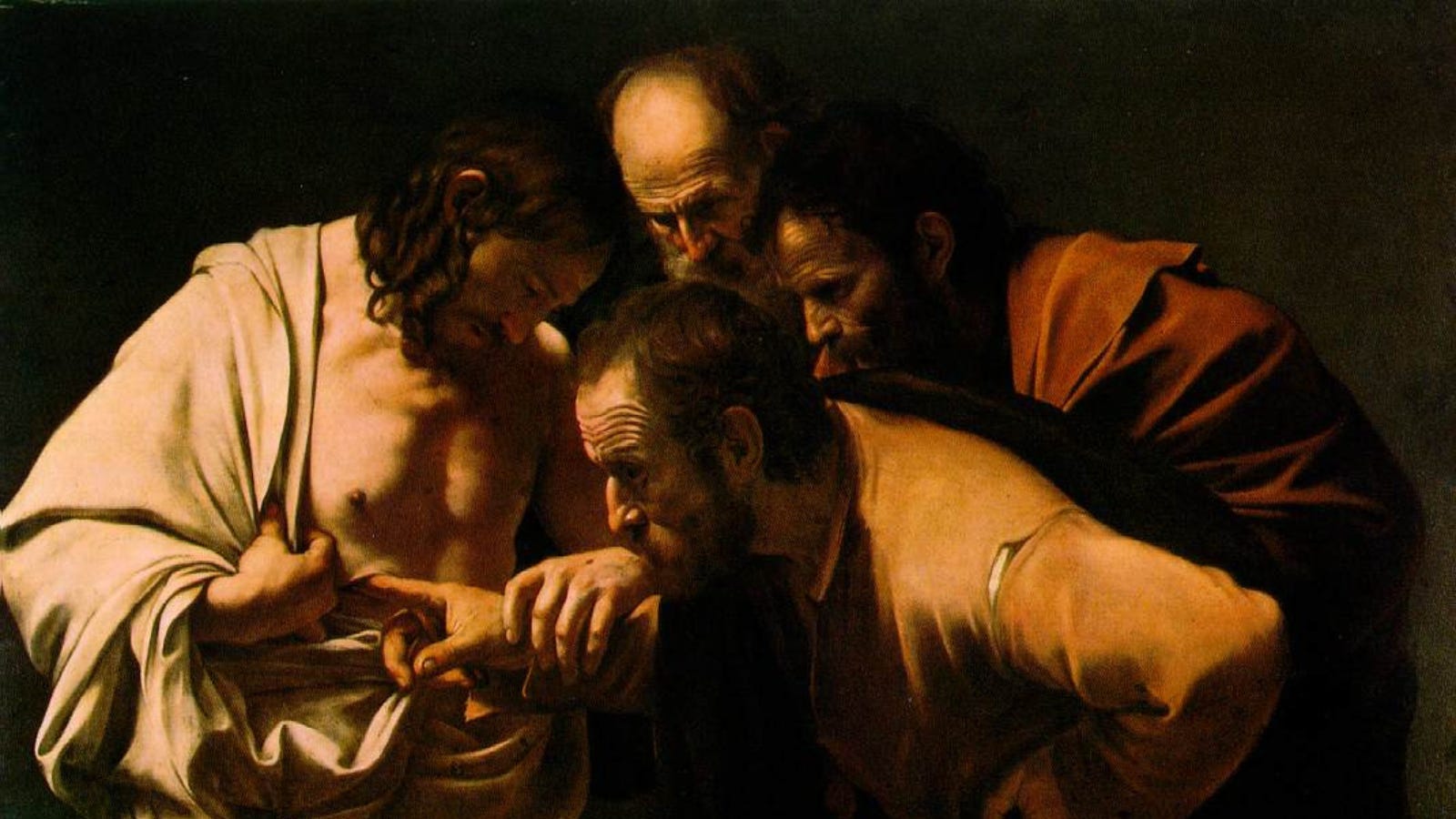
Thomas is often remembered for his doubt, but his words convey something more than uncertainty. This appears to be—as the Italian artist Caravaggio would later portray it—incredulity: the state of being unable to believe.
More accurately, unwilling to believe.
But I understand his resistance. I, too, have dug in my heels with panged unbelief. This is how we respond when the hurt seems to come from heaven itself.
Perhaps the risk of a new injury was too much for Thomas. The wound was still fresh. Seemingly nothing good could come from more vulnerability.
His refusal, however, only heightens the contrast in the next verses:
Eight days later, his disciples were inside again, and Thomas was with them. Although the doors were locked, Jesus came and stood among them and said, “Peace be with you.” Then he said to Thomas, “Put your finger here, and see my hands; and put out your hand, and place it in my side. Do not disbelieve, but believe.”
Thomas answered him, “My Lord and my God!” Jesus said to him, “Have you believed because you have seen me? Blessed are those who have not seen and yet have believed.” John 20:26-29
In the seventeenth century, Caravaggio imagined the scene with unsettling physicality.1 Jesus does not merely display his wounds from a safe distance. With compassionate determination, he takes Thomas by the hand and guides his finger into the opening in his side. Thomas looks both fascinated and disturbed. In the words of my wife, “Honestly, this painting kind of grosses me out.”
Perhaps it should. Caravaggio refused to make the wounds of Jesus tasteful, just as the risen Jesus refused to hide them. He did not ask Thomas to overlook the marks of his suffering or move quickly past them. Rather, he drew Thomas’s attention directly toward them.
The risen Christ makes himself known not despite his scars, but through them.
The Glory of His Wounds
In the perfection of his glorified body, Jesus remains a scarred man. The marks in his hands and feet where the nails were driven, and the cavity in his side where the spear pierced, are among the clearest signs that the risen Christ is the same Jesus who was crucified. Resurrection has not rendered them meaningless or embarrassing. It has disclosed them as signs of his glory.
As David Mathis observes, if Luke and John had not told us about the wounds, we would probably assume that a glorified body would bear no scars. At first, they might appear to be defects—remnants of something resurrection should have erased and forgotten. “That Luke and John testify so plainly to Jesus’s resurrection scars,” Mathis writes, “must mean they are not a defect, but a glory.”2
The book of Revelation gives us the same startling picture. In Revelation 5, John sees Jesus as “a Lamb standing, as though it had been slain” (v. 6). The Lamb bears the marks of slaughter, yet he stands. Crucified, yet risen. Slain, yet enthroned. His wounds do not diminish his beauty. They magnify it. They reveal the nature of the One who conquered through suffering love.
The Wounds That Speak to Ours
In this world, following the Lamb does not spare us from scars of our own. Sometimes they come through circumstances we never chose. Sometimes they come precisely because we chose to follow him.
Love made us vulnerable. Obedience proved costly. Pruning cut to the quick. Service exposed our weakness.
In such experiences, I have been tempted to withdraw in shame. I assume I must have done something wrong—that God has rejected me. I isolate to nurse my scars. I become incredulous, not only about what happened, but about the God I was trying to trust.
Yet each time, I eventually find that the hand reaching for me bears a scar.
The Lamb does not patronize me with a distant “There, there.” He does not explain away the wound or hurry me past it. My ruptured trust begins to heal precisely through his wounds. They show me that the God I fear has abandoned me is the God who entered suffering and still bears its marks.
The Scars We Need Not Hide
The day will come when faith gives way to sight. We will embrace him, hold his hand, feel his arm around our shoulders as we laugh together, pass bread at the table, and sit with our feet in the current. And the Christ we meet will still be the Lamb who was slain. His scars will not be hidden from our eyes. They will remain sure signs of the love that brought us home.
That future can form our life and witness now. If the scarred Lamb stands at the center of the new creation, then his people need not pretend to be unbroken.
We need neither to parade our wounds for effect nor conceal them as disqualifications. We can become a people unashamed of scars, allowing the places where Jesus has reached for us to bear witness to who he truly is.
Edward Shillito called him “Jesus of the Scars”:
“The other gods were strong; but Thou wast weak;
They rode, but Thou didst stumble to a throne;
But to our wounds only God’s wounds can speak,
And not a god has wounds, but Thou alone.”3
"The Incredulity of Saint Thomas (Caravaggio)," Wikipedia, last modified June 27, 2026, https://en.wikipedia.org/wiki/The_Incredulity_of_Saint_Thomas_(Caravaggio)
David Mathis, "His Scars Will Never Fade: The Wounds Christ Took to Heaven," Desiring God, May 18, 2019, https://www.desiringgod.org/articles/his-scars-will-never-fade
Edward Shillito, “Jesus of the Scars,” in The New Perhaps (London: Elkin Mathews, 1919)
This is incredibly beautiful and so timely as I wrestle with the wounds I still carry, as I move forward trusting the One with the scars! ❤️🔥